

Master of Mechanical Equipment Engineering (Online)

Available!
WITH THE ACCESS TO THE COURSE YOU GET:
Access to the Master: 12 months
This master has been developed to be completed in 550 hs, 50 Weeks.
Consultation forum
Queries will be channeled via dedicated forums, our instructors will answer as soon as possible!
Instructor available
An specialist Instructor will be available throughout the entire duration of the course.
Downloadable resources
Study notes, case studies and extra material are downloadable for future reference.
Summary videos
Each lesson includes a summary video with then fundamental concepts dealt with in that lesson for better understanding.
Lessons included
All the lessons indicated in the CONTENTS tab are included.
Assessment questions
Multiple-choice assimilation questions and cases are presented in each lesson to fix fundamental concepts.
Case studies
This is a “hands-on” course. Real cases (and solved) are presented to be developed with the course material.
Calculation sheets
Specific spreadsheets have been developed to simplify the calculation process. Calc sheets are downloadable.
ASME Certificate
A certificate of completion issued by ASME will be submitted upon completion.
FREQUENTLY ASKED QUESTIONS (FAQ’s):
How can I enroll in this Master?
To enroll in this course you have to follow the below steps:
- Click on “Add to cart”
- Complete the purchase process using the payment options available.
- You will receive a confirmation email.
- Start training your skills!
What is the weekly dedication required?
The master has been designed to be completed with an average dedication of 550 hours in 50 weeks. With the help of the Study Notes and the Extra Material included in each module, the participants will deliver the practical cases corresponding to the proposed modules / lessons.
Even when the learning pace is set by each participant, an average dedication of 12-15 hours per week is recommended for a correct assimilation of the contents.
Do I need to send any information?
Yes, you need to send to info@arvenggroup.com the following documentation:
- Copy of your DNI / NIE / Passport
- Copy of the degree obtained
- Updated CV.
Are calculation softwares used?
No. Dedicated calculation spreadsheets have been developed for this Master, they are used for solving the presented case studies.
Who approves this Master?
This Master is approved by ASME and IACET (International Accreditors for Continuing Education and Training).
The certificate is issued by ASME upon completion.
The issuance of the certificate does not entail any additional payment, it is included in the cost of the master.
What forms of payment are there?
If you make a single payment you will benefit from an additional 5% discount. Alternatively, you can pay in 4 installments:
- 1st installment: Parts I and II
- 2nd installment: Part III
- 3rd installment: Part IV
- 4th installment: Part V and Final Project
The means of payment are credit / debit card or PayPal.
Can I register and pay for a 3rd party/more than one person?
To enroll a 3rd paty/more than one person you have to follow the below steps:
- Change the number of products of your cart (1 by default):
a. Change the number of products before clicking on “Add to Cart”.
b. Directly on the cart screen, there is a button where you can increase or decrease the amount of products to buy. - State the Name and Surname of the participants in the observations field when completing the purchase.
Are there discounts for groups/companies?
Yes! Contact us indicating your needs and we will find the most convenient alternative for you.
How can I reserve a seat?
Once the necessary documentation has been sent, you will receive an email with the access codes for the purchase of the master.
You must pay at least the first installment.
Who should attend?
This course is intended for graduates (or soon to be), designers, freelancers, technicians and engineers involved in: calculation, design, selection, manufacturing, safety, quality and maintenance of systems and equipment in industrial processes.
Previous knowledge of this subject is not required to attend to the course.
Training objetives
The main objective of this course is to transfer to participants the theoretical and practical skills required in projects, obtained from experience and sound engineering practices.
What to expect?
Participants will gain the knowledge for design of the main mechanical equipment used in most industrial plants, safe an economical.
At the end of the program, participants will be able to design the main parts of the mechanical equipment proposed.
- Know the organization of the codes and acquire the vocabulary and fundamentals.
- Benefit from the lessons learned and best engineering practices.
- Learn to select materials.
- Define the fluid velocity and obtain the min. diameter for a pipe and a known flow.
- Select the different components of a piping system.
- Calculate the required thickness of the pipe under internal pressure.
- Design and calculate stiffening rings for a pipe under vacuum.
- Learn to perform stress and flexibility analysis on systems using simplified methods.
- Calculate buried piping systems.
- Become familiar with the basics of a pipe layout.
- Learn to interconnect pipes with the main equipment.
- Understand the main differences between the types of supports.
- Learn to select rigid and spring supports.
- Learn to design and calculate the main parts of a pressure vessel.
- Understand and apply the Joint Efficiency concept.
- Learn to deisign Legs, Skirs and Saddles.
- Define the wind profile and seismic loads.
- Design and calculate stiffening rings for a pressure vessel under vacuum.
- Learn to design different types of nozzles: built up, self-reinforced, integral.
- Learn to design Non-Standard Flanges.
- Understand the different configurations of Heat Exchangers.
- Learn to design a heat exchanger from a mechanical point of view.
- Design the tube bundle and calculate the thickness of the tubesheet.
- Learn to verify the thickness of the transfer tubes.
- Learn to design and calculate the main parts of a storage tank.
- Design and calculate stiffening rings for the tank wall.
- Define the anchorage requirements due to earthquake and the wind.
- Understand the main differences between roof types.
- Learn to design and calculate fixed roofs and their internal support structure.
- Obtain the seismic spectrum, wind loads and verify the overturning moment.
- Design anchor bolts of static equipment due to combined loads.
CONTENTS AND STRUCTURE OF THE COURSE: 550 HS
PART I: Introduction to Mechanical Equipment (10 hs)
Introduction
Design of piping systems
Importance of the pipe system
Pipe specification
Layout in plan
Pipe flexibility analysis
Design of pressure vessels
Vessels
Reactors
Columns
Storage system design
Aboveground storage tanks
Spheres
Cigars or “Bullets”
Shell and Tube Heat Exchangers Design
Shell and Tube Heat Exchangers
Double Tube Heat Exchangers (Fin Tube)
Aero-coolers (Air Coolers, Air Fins, Fin Fans)
Plate heat exchangers
PART II: Design of Piping Systems (120 hs)
Applicable Codes
ANSI Code
ASTM Code
ASME B31 Code
Design Loads
Sustained Loads
Displacement Loads
Occasional Loads
Proposed Case Studies
- Vocabulary and terminology
- ASME B31 Code Organization, Scope
- Design Loads
- Operating Conditions
Flow of fluids in pipes
Properties of fluids
Flow of fluids
Energy conservation law
Pressure loss
Pressure loss in straight runs
Pressure loss in fittings
Proposed Case Studies
- Application of energy conservation law
- Pressure loss in straight runs
- Pressure loss in fittings
- Optimal diameter calculation
Material selection
Corrosion types
Corrosion Allowance
Essential properties of materials
Allowable stress
Material designation
Most used materials
General requirements
Proposed Case Studies
- Vocabulary and terminology
- Manufacturing methods
- Materials designation
- Allowable Stress selection
Types of pipes
Schedule & Calibrated pipes
Joining methods
Components
Pipes, flanges and fittings
Valves specification
Piping class
Proposed Case Studies
- Applicable specifications
- Commercial thicknesses
- Flange selection
- Piping class
Purpose of insulation
Selection parameters
Insulation Calculation
Effective thickness
Cold & hot piping insulation
Thickness selection
Insulation installation
Proposed Case Studies
- Insulating materials properties
- Insulation thickness calculation
- Effective thickness calculation
- Insulation specification
Stresses in cylindrical shells
Thin walled cylinders
Thickness calculation procedure
ASME B31.1 Formulae: Power Piping
ASME B31.3 Formulae: Process Piping
ASME B31.4 Formulae: Pipeline Transportation
ASME B31.8 Formulae: Gas Transport
Commercial thickness selection
Proposed Case Studies
- Allowable stress selection
- Selection of pipe coefficients
- Thickness calculation
- Commercial thickness selection
Applicable Codes
Failure Mechanisms
Moment of Inertia of the System
Support Lines
System verification
Wall thickness and Stiffening rings
Best Practices
Proposed Case Studies
- Thickness verification against external pressure
- Distance between support lines
- Design of Stiffening Rings: Case Study
- Pipe + Rings Verification: Case Study
Introduction
Design Codes
Terrain Importance
Design Considerations
Loads Definition
Stress Verification
Failure Modes
Installation
Proposed Case Studies
- Vertical Loads of the terrain
- Superficial Live Loads
- Ovalization and Induced Stress
- Stress due to flotation
Basic Philosophy
Piping Layout Specification
Plot Plan
Equipment Location
Piping Arrangement
Distance between Equipment
Pipe Rack
Proposed Case Studies
- Plant Access Requirements
- Minimum Distance between equipment
- Platforms & Stairs requirements
- Minimum distance between pipes
Importance of an adequate Layout
Equipment Interconnection
S&T Heat Exchangers
Air Coolers
Compressors
Pressure Vessels
Centrifugal Pumps
Instrumentation Piping
Proposed Case Studies
- Basic Rules for a good design
- Interconnection with Heat Exchangers
- Interconnection with centrifugal pumps
- Interconnection with Pressure Vessels
Introduction
Stages in Flexibility Analysis
Thermal expansion of piping
Induced loads due to Thermal Expansion
Induced Stresses in the pipe
Pipe Allowable Stresses
Simplified Analytical Calculation
Proposed Case Studies
- Thermal expansion calculation
- Induced force due to thermal expansion
- Turns to absorb the thermal expansion
- Expansion Loops calculation
Introduction
Supports functions
Classification
Commercial & Structural Supports
Types of Supports
Symbology
Location
Supports Selection
Proposed Case Studies
- Supports Symbology
- Rigid & Flexible Supports Selection
- Structural Supports calculation
- Minimum distance between supports
PART III: Design of Pressure Vessels (120 hs)
Configuration and design codes
Pressure vessel parts, Geometry definition
ASME BPVC – Boiler and pressure vessel code
Historical review, BPVC Sections
ASME BPVC Section VIII, Div.1
Scope, Code organization
ASME stamp
Code revisions
Proposed Case Studies
- Vocabulary and terminology
- Key Concepts in Design Codes: Quiz
- ASME VIII Code organization, scope
- Key Concepts in ASME VIII: Quiz
Internal attachments
Tray supports, Beds’ support
Internal piping / distributors
Vortex breakers, Demisters
External attachments
Clips, Davits, Lifting devices
Insulation, Fireproofing
Platforms, Ladders
Proposed Case Studies
- Vocabulary and terminology
- Identification of internal attachments: Quiz
- Identification of external attachments: Quiz
- Attachments weight estimation
Design Conditions
Temperature, Pressure
Corrosion Allowance
Loadings
Permanent | Temporary
Cyclic | Local
Vessel Weights
Shell | Heads | Nozzles | Skirts
Proposed Case Studies
- Key Concepts in Design Conditions Quiz
- Key Concepts in Loadings Quiz
- Vertical PV Weight Estimation: Case Study
- Horizontal PV Weight Estimation: Case Study
Material selection
Corrosion types
Corrosion Allowance
Essential properties of materials
Material designation
Most used materials
ASME Tables
General requirements
Proposed Case Studies
- Vocabulary and terminology
- Materials designation
- Allowable Stress selection
- MDMT Verification
Joint Efficiency
Welded joints, Joint types
Service requirement
Welded joint evaluation
Joint efficiency value
Selection charts
The full or spot dilemma
Proposed Case Studies
- Vocabulary and terminology
- Key Concepts in Joint Efficiency Quiz
- Vertical PV Joint Efficiency Selection: Case Study
- Horizontal PV Joint Efficiency Selection: Case Study
Design of parts under Internal Pressure
Stresses in cylindrical shells
Cylindrical | Spherical shells
Fabrication of shells
Types of Heads: Hemispherical, Elliptical heads
Torispherical heads, Flat heads
Fabrication of heads
Conical transitions | Toriconical transitions
Proposed Case Studies
- Calc’s of Cylindrical & Spherical Shells: Case Study
- Calc’s of the different types of Heads: Case Study
- Calc’s of Conical, Toriconical transitions: Case Study
- Calc’s of Flat Covers: Case Study
Design of parts under external pressure
Support lines, Cylindrical shells
Shell under external pressure
Stiffening rings under external pressure
Spherical shells
Heads and conical transitions
Conical heads & transitions
Proposed Case Studies
- Key concepts in External Pressure: Quiz
- Calc’s of PV against external pressure: Case Study
- Design of Stiffening Rings: Case Study
- Shell + Rings Verification: Case Study
Nozzles
Nozzle Configurations
Standard flanges, Gaskets
Nozzle necks, Calculation
Reinforcement
Reinforcement requirement
Calculation methods
Self-reinforced and integral nozzles
Proposed Case Studies
- Key concepts in Nozzle Design: Quiz
- Nozzle Neck Calculation: Case Study
- Reinforcement Pad Calculation: Case Study
- Self-reinforced nozzles Calculation: Case Study
Non-standard flanges
Design criteria, Load definition
Flange types
Bolts & Gaskets
Gaskets
Design of Non-standard flanges
Flange design steps
Sound engineering practices
Proposed Case Studies
- Key Concepts in Non-Std Flange design: Quiz
- Types of Non-Standard Flanges: Case Study
- Calculation of Integral Flanges: Case Study
- Calculation of Loose Flanges: Case Study
External loads
Wind pressure
Seismic loads
Period of Vibration (POV)
Vertical vessels: skirt, legs
Horizontal vessels: saddles
Allowable stress & loads combination
Proposed Case Studies
- Key Concepts in External Loading: Quiz
- Wind Pressure & Seismic Profile: Case Study
- Definition of loads action on the vessel: Case Study
- Base shear & overturning moment calc: Case Study
Skirt design
Types of shell-to-skirt joint
Skirt thickness calculation
Skirt saddle design
Tall towers, Lugs
Legs design
Profile cross section, Legs standard
Verification of legs
Proposed Case Studies
- Key Concepts in Skirt & Legs design: Quiz
- Design and Calculation of Skirts: Case Study
- Design and Calculation of Legs: Case Study
- Design and Calculation of Anchor Bolts: Case Study
Saddles design
Location of saddles
Components
Saddles standard
Verification of saddles
Anchor bolts
Thermal expansion
Proposed Case Studies
- Key Concepts in Saddles design: Quiz
- Design and Calculation of Saddles: Case Study
- Shell Verification against over stress: Case Study
- Design and Calculation of Anchor Bolts: Case Study
PART IV: Design of Shell & Tube Heat Exchangers (120 hs)
Introduction
TEMA Code
Application, Organization, Scope
HEI Code
Application, Organization, Scope
API 660 Code
Application, Organization, Scope
Comparison & Compatibility
Proposed Case Studies
- Parts of a Heat Exchanger
- Key Concepts in Design Codes: Quiz
- TEMA Code organization, scope
- Compatibility between codes
Shell & Tube Heat Exchangers
Tube Side | Shell Side
Main Elements
Types of Heat Exchangers
S&T Heat Exchangers Configurations
Tubes Arrangement
Number of passes in the Tube Side
Number of passes in the Shell Side
Proposed Case Studies
- Conceptual Questions
- Identification of Main Elements
- Exchanger Type Selection
- Number of Tubes calculation
Design Conditions
Loads
Sustained, Occasional
Cyclic Loads | Local Loads
Weight Estimation
Shell, Heads, Body Flanges
Tubesheets, Tubes, Nozzles
Supports | Insulation
Proposed Case Studies
- Key Concepts in Design Conditions Quiz
- Unitary Weights Estimation
- Components Weights Estimation
- Design Weights Calculation
Material selection
Corrosion types
Corrosion Allowance
Essential properties of materials
Material designation
Most used materials
ASME Tables
General requirements
Proposed Case Studies
- Vocabulary and terminology
- Materials designation
- Allowable Stress selection
- MDMT Verification
Joint Efficiency
Welded joints, Joint types
Service requirement
Welded joint evaluation
Joint efficiency value
Selection charts
The full or spot dilemma
Proposed Case Studies
- Vocabulary and terminology
- Joint Category
- Welded Joints Specification
- Joint Efficiency Selection: Case Study
External elements design
Cylindrical shells
Types of heads
Hemispherical | Elliptical | Torispherical
Flat Covers
Transitions
Conical transitions
Toriconical transitions
Proposed Case Studies
- Calc’s of Cylindrical & Spherical Shells: Case Study
- Calc’s of the different types of Heads: Case Study
- Calc’s of Conical, Toriconical transitions: Case Study
- Calc’s of Flat Covers: Case Study
Design of parts under external pressure
Support lines, Cylindrical shells
Shell under external pressure
Stiffening rings under external pressure
Spherical shells
Heads and conical transitions
Conical heads & transitions
Proposed Case Studies
- Key concepts in External Pressure: Quiz
- Calc’s of PV against external pressure: Case Study
- Design of Stiffening Rings: Case Study
- Shell + Rings Verification: Case Study
Tube Bundle Design
Tubesheet
Tube bundle structure
Baffles: longitudinal | transversal
Heat transfer tubes
Tube – tubesheet joint
Floating heads
Impingement plate
Proposed Case Studies
- Tube bundle configuration
- Tubesheet thickness calculation
- Transfer tubes thickness calculation
- Minimum thicknesses
Nozzles
Nozzle Configurations
Standard flanges, Gaskets
Nozzle necks, Calculation
Reinforcement
Reinforcement requirement
Calculation methods
Self-reinforced nozzles
Proposed Case Studies
- Key concepts in Nozzle Design: Quiz
- Nozzle Neck Calculation: Case Study
- Reinforcement Pad Calculation: Case Study
- Self-reinforced nozzles Calculation: Case Study
Non-standard flanges
Design criteria, Load definition
Flange types
Bolts & Gaskets
Gaskets
Design of Non-standard flanges
Flange design steps
Sound engineering practices
Proposed Case Studies
- Key Concepts in Non-Std Flange design: Quiz
- Flange geometry design
- Joint selection / characteristics
- Non-standard flange verification
Loads acting on Heat Exchangers
Wind Pressure
Shear force
Overturning moment
Seismic Loads
Period of Vibration (POV)
Shear force at the base
Overturning moment
Proposed Case Studies
- Key Concepts in External Loading: Quiz
- Wind Pressure & Seismic Profile: Case Study
- Base shear calc: Case Study
- Overturning moment calc: Case Study
Saddles design
Location of saddles
Components
Saddles standard
Geometry definition
Verification of saddles
Anchor bolts
Thermal expansion
Proposed Case Studies
- Key Concepts in Saddles design: Quiz
- Design and Calculation of Saddles: Case Study
- Shell Verification against over stress: Case Study
- Design and Calculation of Anchor Bolts: Case Study
PART V: Design of Storage Tanks (120 hs)
Design Codes
API 650 code
Code organization, Scope
Other applicable codes
Design conditions
Design loads
Internal and External pressure
Design temperature
Proposed Case Studies
- Vocabulary and terminology
- Code organization, scope
- Design Loads icon=”far fa-bookmark” badge=”activity”
- Operating conditions
Material selection
Corrosion types
Corrosion Allowance
Essential properties of materials
Material designation
Most used materials
General requirements
Proposed Case Studies
- Vocabulary and terminology
- Materials designation
- Allowable Stress selection
- MDMT Verification
Design Considerations
One-foot calculation method
Thickness due to Liquid Level
Minimum Thickness
Fabrication requirements
Welding
Non-destructive examination
Hydrostatic Test
Proposed Case Studies
- Material Selection, Allowable Stress
- Number and height of shell courses
- Thickness calc’s
- Nominal plate thicknesses
Bottom plates design
Plates arrangement, minimum thickness
Annular ring
Width calculation, minimum thickness
Fabrication requirements
Plate edge finishing
Welding
Proposed Case Studies
- Material Designation (shell, bottom, annular ring)
- Mechanical properties
- Annular ring requirement
- Bottom plate thickness & annular ring
Tank shell stability
Top ring
Self-supported roofs
Supported roofs
Tank shell stiffeners due to wind
Top and Intermediate rings
Profile selection
Proposed Case Studies
- Top ring profile selection
- Top angle calculation
- Transformed height calculation
- Intermediate rings calculations
Design considerations
External pressure verification (Vacuum)
External pressure range
Tank shell verification
Load combinations: wind + pressure
Wind girders
Number of girders and spacing
Moment of inertia required
Proposed Case Studies
- Transformed height calculation
- Design external pressure/Allowable calculation
- Number and spacing of rings
- Standard profile selection
Types of fixed roofs
Conical type
Dome & umbrella type
Fixed roofs configuration icon=”far fa-bookmark” badge=”activity”
Self-supported roof
Supported roof
Structure for supported roofs
Proposed Case Studies
- Self-supported roof calculation
- Loads and plate thickness
- Supported roof calculation
- Frame & columns calculation
Floating roof selection
External floating roof
Single & double deck roofs
Floating roofs appurtenances
Buoyancy – Pontoon design
Internal floating roof
Types of roofs
Design requirements, materials
Proposed Case Studies
- Material properties
- Pontoon design
- Pontoon buoyancy verification
- Deck stress verification
Nozzle configuration
Standard flanges
Nozzle necks
Reinforcements
Nozzles in tanks
Tank shell nozzles
Tank roof nozzles
Cleaning nozzles
Proposed Case Studies
- Material selection
- Material designation for components
- Flange selection / Rating
- Nozzle selection as per code
Wind loads
Wind profile according to job site
Wind speed and pressure
Wind overturning verification
Impose loads
Overturning resistance
Tank sliding due to wind
Proposed Case Studies
- Tank components weight
- Overturning moment calculation
- Resistant moment verification
- Tank horizontal sliding verification
Seismic Loads
Seismic Spectrum (accelerations)
Overturning moment & base shear
Vertical loads
Design loads verification
Resistant moment
Sliding verification
Freeboard requirement
Proposed Case Studies
- Seismic parameter definition
- Tank components weight calculation
- Overturning moment & base shear calc
- Resistant loads verification
Anchor bolts requirements
Wind loads
Seismic loads
Internal pressure
Tank uplift
Bolts number and cross-section
Chairs design
Proposed Case Studies
- Anchor bolts requirement
- Factor J & sliding calculation
- Uplift load calculation
- Bolts number & cross-section calc
PART VI: Final Master’s Project (60 hs)
The end-of-master project consists of the design and calculation of the drive, conditioning, storage and injection system of demineralized water in gas turbines of a power generation plant.
To carry out the project, participants will have to:
- Size piping systems according to the required flow
- Calculate the pressure drops of the system
- Design and calculate the demi water storage tank
- Select and design the support of the piping systems
- Design and calculate the heat exchanger for water cooling
TRY THIS COURSE BEFORE ENROLLING!
You can study the structure, contents and methodology before enrolling. You can also watch the introductory videos and solve the test in Lesson 1! Leave us your contact information and we will send the instructions to access the Virtual Campus:
EXAMPLE OF A CERTIFICATE ISSUED BY ASME:
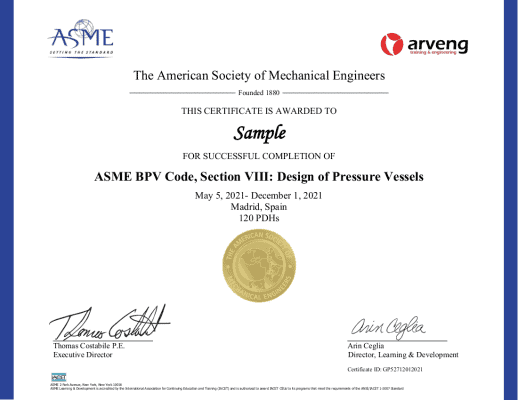
Upon successful completion of the course participants will earn 550 PDH’s, equivalent to 55 CEU’s.
This recognition can only be obtained with the ASME certificate.
PDH: Professional Development Hour
CEU: Continuing Education Unit
REQUEST MORE INFORMATION!
Leave us your contact details and we’ll send you the information.
About Instructors

Javier Tirenti
Senior Mechanical Engineer and Master in Business Administration (MBA). More than 20 years of experience in design, calculation, selection and fabrication of mechanical equipment and structures in general. Vast experience providing specific training sessions in both classroom and online approaches.
Add a review
You must be logged in to post a review.
 WhatsApp
Murphy B.
I consider the quality of the course to be excellent. The methodology used is simply brilliant, one of the best I have experienced in online training. All the material is very well thought out and worked on, it is very easy to follow and is also useful for working.
Tini Lang
I would just like to thank the tutor for his attention and the way the platform works, both of which are excellent.
Thomas M.
I found the online course platform very easy to use. I think the structure and teaching resources are very clear. As for learning, I value the tutor’s speed in responding and the clarity of his answers.
Faik Refai
As a Piping and Mechanical Engineer, I have increased my technical knowledge and experience during the study of this course, the course content is covering a wide range of topics in Piping and Mechanical engineering, Thanks a lot to Mr. Javier for his prompt responses to my queries during the course.
Tamara S.
Thank you for the excellent course.
Maylin P.
I have been fascinated by knowing and taking this course, excellent attention from the professor, very good exchange and teaching towards my doubts.
Antoni G.
I am very satisfied with the result of the course. The tutor always responded on time to each question. I learned a lot. Thank you so much.
Peter J.
Really good training.
Luz A.
Very happy with the course, everything has been excellent, the platform has worked correctly, and no problems. To highlight the great professionalism of the tutor, his great work and his concern in resolving and helping with doubts, which has greatly facilitated the development of the course.
Felix J.
I have been very satisfied with the course, very beneficial for my training, I hope to take more courses with you in the future, thank you very much and congratulations for your work.
Rachel E.
I found it to be a useful, organized and very well explained course. Whenever I have had any questions, the tutor’s answers have been clear and very complete.
Ignacio U.
This course has pleasantly surprised me. Its approach has been appropriate considering how broad it is.
Lluís V.
Overall, the platform, content and attention seemed very good to me. Thank and congratulate Javier for his attention and the feedback received at the end of the activities to be delivered. Thank you so much.
Mohammed
I have recommended this course for several people within my field. It is very thourogh. Overall, the course is very beneficial, straight forward and covers all the required criteria to obtain a full knowledge about industrial plants.
Thank you for the course.
Prathamesh S.
Course excellently designed.
Georgios L.
The course is well structured and guides the student to understand the fundamental concepts. I really enjoyed it and will recommend it.
John J.
This is an excellent course that gives you confidence in conducting preliminary detailed designs for new equipment or adequacy checks of new designs. The notes are clear and concise and digest a huge volume of ASME standards and references to specific details relevant to calculating and designing the mechanical components.
Ibn I.
If you are a Mechanical (Static) and Piping Engineer and you seeking to endorse your experience with a higher degree, then I would fully encourage you to attend and enroll into this master program.
Honestly, the ‘Online Master of Mechanical Equipment Engineering’ is great and very useful. The materials (study notes) and videos are well prepared, organized and illustrated well the technical understanding of most cases. Moreover the assignments and tests are emphasizing and deepen the understanding of the subjects.
I really enjoyed this master, and looking forward to see another programs…
Finally, I would like express my gratitude to Arveng team and to Mr. Javier Tirenti for their continuous support.
John
This is an excellent course that gives you confidence in conducting preliminary detailed designs for new equipment or adequacy checks of new designs. The notes are clear and concise and digest a huge volume of ASME standards and references to specific details relevant to calculating and designing the mechanical components.
Efthymios
In general, this Master covers a wide range of mechanical equipment field. In addition, it offers useful knowledge and you can learn in an easy way. Very well organized with detailed notes for each lesson. Precise questions and case studies. Ongoing support and feedback. Details and very useful spreadsheets and examples.
Ibn Abbas
If you are a Mechanical (Static) and Piping Engineer and you seeking to endorse your experience with a higher degree, then I would fully encourage you to attend and enroll into this master program.
Honestly, the ‘Online Master of Mechanical Equipment Engineering’ is great and very useful. The materials (study notes) and videos are well prepared, organized and illustrated well the technical understanding of most cases. Moreover the assignments and tests are emphasizing and deepen the understanding of the subjects.
I really enjoyed this master, and looking forward to see another programs, specially the advance ones such as: Piping Stress Analysis, Expansion Joints selection, Local Stress Check WRC, Heat Exchanger’s Expansion Joint Design, FFS for Pressure Vessel …etc
Finally, I would like express my gratitude to Arveng team and to Mr. Javier Tirenti for their continuous support.
Louise
The course is excellent and very informative. I would highly recommend this course to anyone who wants to increase their knowledge and experience.
isurs
Very good course! Very detailed and well oriented. And Javier is also available for any kind of doubt or question.
Juhyung
Thank you for offering a great course. It was really helpful!
Luigi
the course is very completed