


In the complex ecosystem of the industrial sector, critical decision-making in engineering represents the nexus between a project’s economic viability and a plant’s operational safety. It is not simply about applying a formula; it is about managing uncertainty in environments where variables do not always behave according to ideal models.
The Weight of the Signature: Technical Responsibility and Professional Ethics
For an engineer, signing a drawing or validating a report is not an administrative act. On the contrary, it is a declaration of safety. In most jurisdictions, this signature carries civil and criminal liability.
Approving an alternative material or changing a support configuration is never trivial. Consequently, these actions define process safety. They determine if a facility operates smoothly or becomes a latent risk to the environment.
Methodology for Decision-Making Under Uncertainty
To avoid decisions based on assumptions or commercial pressures, a senior engineer must structure their judgment under a rigorous technical validation process. This workflow ensures that the decision is defensible during audits, by insurance companies, or in the event of operational failures.
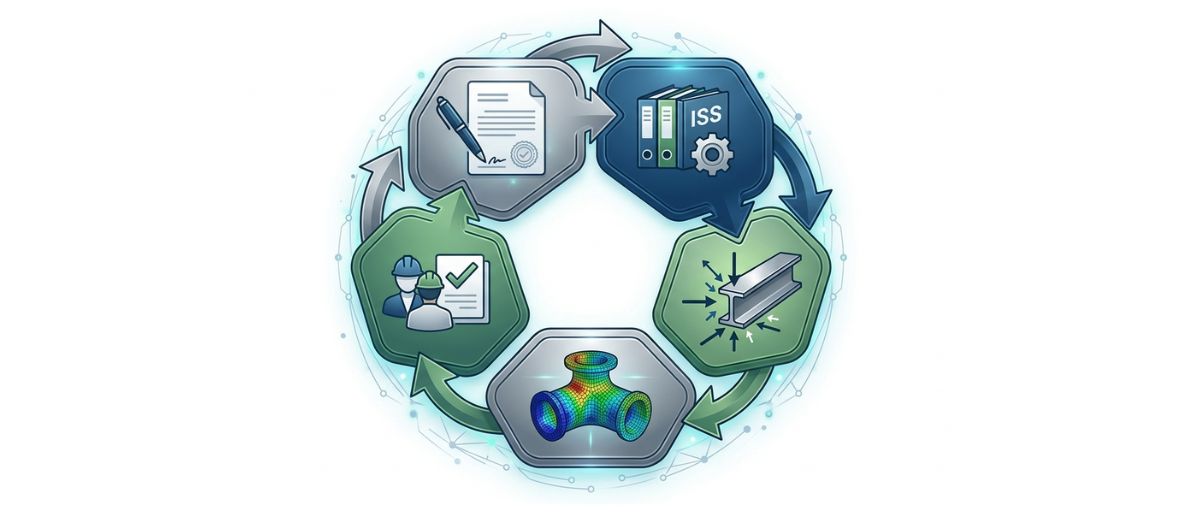
The process begins with consulting international safety standards and design codes (such as ASME or API)
This process is based on the following pillars of technical execution:
1. The Hierarchy of Codes and Standards (ASME, API, EN)
The foundation of any solid decision is regulatory compliance. However, while codes establish minimum requirements, they do not cover all specific operating conditions or damage mechanisms. Standards such as ASME Section VIII (Pressure Vessels) or B31.3 (Process Piping) provide safety requirements, but that doesn’t mean every “real-world situation” is covered.
-
Beyond Compliance: In high-criticality situations, the engineer must decide if the minimum requirements are sufficient. For instance, in services involving hydrogen or lethal fluids, material selection and the level of non-destructive examination (NDE) must exceed base code stipulations to mitigate damage mechanisms such as hydrogen embrittlement, HIC/SOHIC, or additional inspection requirements for Category M services per ASME B31.3.
-
Standard Conflicts: Discrepancies between client standards (DEP, GP, etc.) and international codes are common. Decision-making in these cases requires a Gap Analysis to consistently prioritize the most conservative solution from a structural integrity perspective.
2. Managing Uncertainty: Safety Factors vs. Operational Reality
One of the greatest challenges in critical engineering decision-making is managing safety margins against input data uncertainty, material property dispersion, and real-world operational variability. An overly conservative design (over-engineering) drives up capital expenditures (CAPEX) and complicates field execution. Conversely, a design pushed to the limit can lead to premature fatigue failure.
-
Assessment of Transient States and Fatigue: Many decisions fail because only the “design case” (steady-state) is considered. Critical decisions must integrate transient states: hot start-ups, emergency trips, and cleaning or steam-out conditions, where thermal gradients can generate stresses that triple those of normal operation.
-
Modeling and Simulation: When analytical formulas are insufficient, the use of Finite Element Analysis (FEA) or Computational Fluid Dynamics (CFD) allows for the visualization of real stress behavior, facilitating a decision based on data rather than assumptions.
3. Fitness-for-Service (FFS) and Integrity Assessment
In the management of assets in service, the most critical technical decision is often the dilemma between immediate intervention or postponement until the next scheduled Turnaround.
Indispensable, the API 579-1/ASME FFS-1 methodology provides the framework for this. It is not a subjective visual inspection, but a quantitative assessment of defects (such as corrosion-induced metal loss, pitting, geometric distortions, or crack-like flaws) conducted through Levels of Assessment (Level 1, 2, or 3).
This analysis determines whether the equipment is fit to continue operating safely under its current parameters or if it requires a derating of operating conditions, service limitations, or a reinforced inspection plan. This represents the ultimate expression of technical judgment: the ability to balance structural integrity with the economic impact of an unscheduled shutdown.
The Human Factor: Managing Biases and External Technical Validation
Even with the most advanced software tools, decision-making remains vulnerable to cognitive biases. Familiarity bias or the pressure to meet project schedule milestones can push a team to overlook critical details during detail engineering, which often leads to costly change orders in later phases.
-
Peer Review: This practice consists of subjecting a high-criticality technical decision to the scrutiny of an independent authority who did not participate in the original design. It is the most effective method for validating initial assumptions and detecting conceptual errors before they reach fabrication.
-
Engineering Judgment: Beyond software results, judgment is a competency forged through exposure to real-world field failures and lessons learned. A senior engineer possesses the necessary vision to identify when a solution that is “theoretically valid” in the model is unfeasible during assembly, operation, or preventive maintenance.
Tailored Consultancy: Your Strategic Technical Backup
At Arveng Engineering, we know that the weight of critical decisions should not rest on a single person. Our Tailored Experts service acts as an extension of your technical office, providing the necessary external technical authority to validate your most complex projects.
We have specialists with more than 20 years of experience in mechanical design under various standards, advanced analysis such as FEA and fatigue, and technical assistance in multidisciplinary projects, ready to cross-check your calculations, resolve regulatory doubts, or support you during design reviews with your clients.
Maximize your professional safety: Our intervention does not only guarantee technical compliance; it also optimizes your processes, reduces uncertainty, and provides the confidence that only an expert and proven judgment can offer.
First Session at No Cost: To let you experience the rigor of our method, your first consulting session is free of charge and with no obligation. We analyze your technical challenge and give you an honest view of how we can strengthen your decision-making.
Request your free technical consulting session here and secure your next project.
 WhatsApp