


Designing an industrial plant requires much more than performing mass and energy balances. Furthermore, it is fundamental to consider how the system must react to operational failures or unforeseen events. Alarms and protections in industrial processes act as the necessary barrier to prevent exceeding safety limits. Consequently, thanks to these systems, facilities are protected against pipe ruptures, fires, or personal risks.
Such safety is reflected in P&IDs through instrumentation dedicated to monitoring critical variables. Specifically, these components intervene on key equipment to halt abnormal conditions before permanent damage occurs.
1. Alarms in Industrial Processes
Different alerting systems detect hazardous conditions to ensure plant continuity. Alarms, specifically, inform the operator of any deviation in control parameters.
-
Types: There are different types of alarms depending on the condition they detect, such as temperature, pressure, level, flow alarms, etc.
-
Importance: They allow for a timely operator response, thus preventing process degradation or an accident.
-
Considerations: It is important for alarms to be relevant, clear, and not cause operator information overload.
2. Safety Protections and Interlocks
Protection mechanisms, or interlocks, modify the process state to prevent emergency shutdowns. These logical functions, termed interlocks, generate discrete signals that force devices into a safe position.
-
Function: To stop or modify the process to prevent damage or accidents.
-
Types: They can be automatic (such as an emergency shutdown system) or manual (such as operator intervention to change process operation).
Differences between Trip and Permissives
Regarding the Trip, it is a type of interlock that forces a predetermined state and requires a manual reset. Even if the variable returns to a safe condition, the equipment will not start until it is physically enabled. For instance, common examples include a pump trip or the opening of a safety valve.
In contrast, a permissive is a precondition that prevents actions until predefined safety requirements are met. As an illustration, a pump will not start if there is no minimum level in the suction tank. Once the pump is running, the permissive action is typically disabled.
Safety Representation in the P&ID
Alarms and interlocks shall always be represented in a P&ID. In this way, from the design phase, engineers verify how the process reacts if a variable exceeds its limits. Moreover, permissives are detailed in the control narratives to indicate the logical operation of the system.
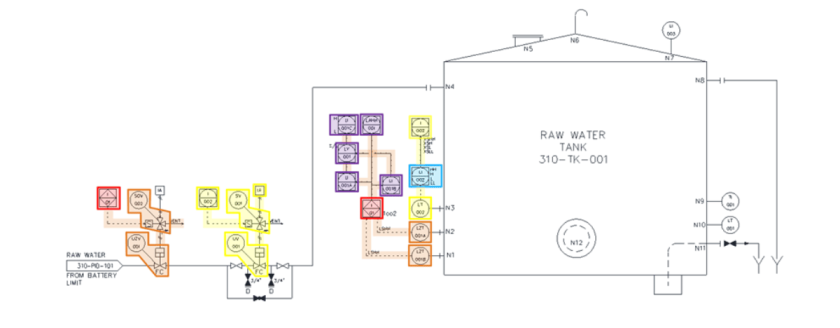
In the following figure, an extract of a P&ID is shown where alarms and protections can be seen:
Technical Analysis of the P&ID Extract
In yellow, the level control loop; in orange, the level protection loop.
In light blue, the alarms in the DCS are shown, alerting the operator that the level may be:
-
-
HH: High-High
-
H: High
-
L: Low
-
LL: Low-Low
In case of a high level, the process interlock I-002 will act on valve UV-001 via SV-001. If the level is very low, the 3-way valve will position itself to add instrument air to UV-001 so that it opens (note that the valve is Fail Closed – FC). If the level is very high, the 3-way valve will switch to the vent position to remove instrument air from the UV-001 actuator so that it closes.
In purple, the alarms of interlock I-01 are shown, which warn the operator that the process variable is deviating from normal operating values. In this case, the High-High level alarm LAHH-001 is the alarm that activates interlock I-01.
Interlock I-01 acts on UZV-001 via the 3-way valve SOV-002 in the same manner as explained for UV-001 and SV-001. Valve UZV-001 will close on High-High level, preventing tank 310-TK-001 from overflowing.
Conclusion:
Implementing appropriate process protection systems in P&IDs prevents serious operational problems. In short, a correct definition of these loops ensures the integrity of the assets and the safety of the personnel.
 WhatsApp